When we think of chocolate—or any food — production, we think of aromas, shapes, and taste. But behind every perfect bar there are high-precision mechanical processes and machines that must operate continuously and cleanly, and components that must ensure maximum reliability even in challenging environments.
In an industry where every interruption can lead to wasted raw materials or costly downtime, even a small detail—like choosing the right coupling—can make a big difference.
That’s why more and more food manufacturers are choosing couplings specifically designed for hygienic, durable and maintenance-free operation.
Mechanical Challenges in the Food Industry
Professionals working in food-related mechanics know that the production environment is far from simple.
Machines must cope with unique conditions: sugary or greasy residues, humidity, frequent washdowns, temperature fluctuations, continuous duty cycles and strict hygiene standards.
The main issues typically encountered in mechanical transmissions within the food sector include:
- Vibrations and misalignments that compromise motion precision;
- Premature wear of components due to contamination from sugars and powders;
- Frequent need for lubrication, increasing maintenance time and contamination risks.
The goal today is to design maintenance-free transmissions, compatible with food environments and capable of ensuring consistent motion over time.
And this is where the right coupling makes all the difference.
Case Study: A Chocolate Production Line
One of our clients, a chocolate manufacturer, contacted us because the transmission system in one of their processing machines was experiencing micro-vibrations and inconsistent motion.
Additionally, the frequent need to lubricate the coupling was causing machine stoppages and residue buildup, reducing productivity.
The requirement was clear: maintain a smooth, consistent, and clean movement, eliminating the need for periodic maintenance.
The Solution: The GSTR Elastic Coupling
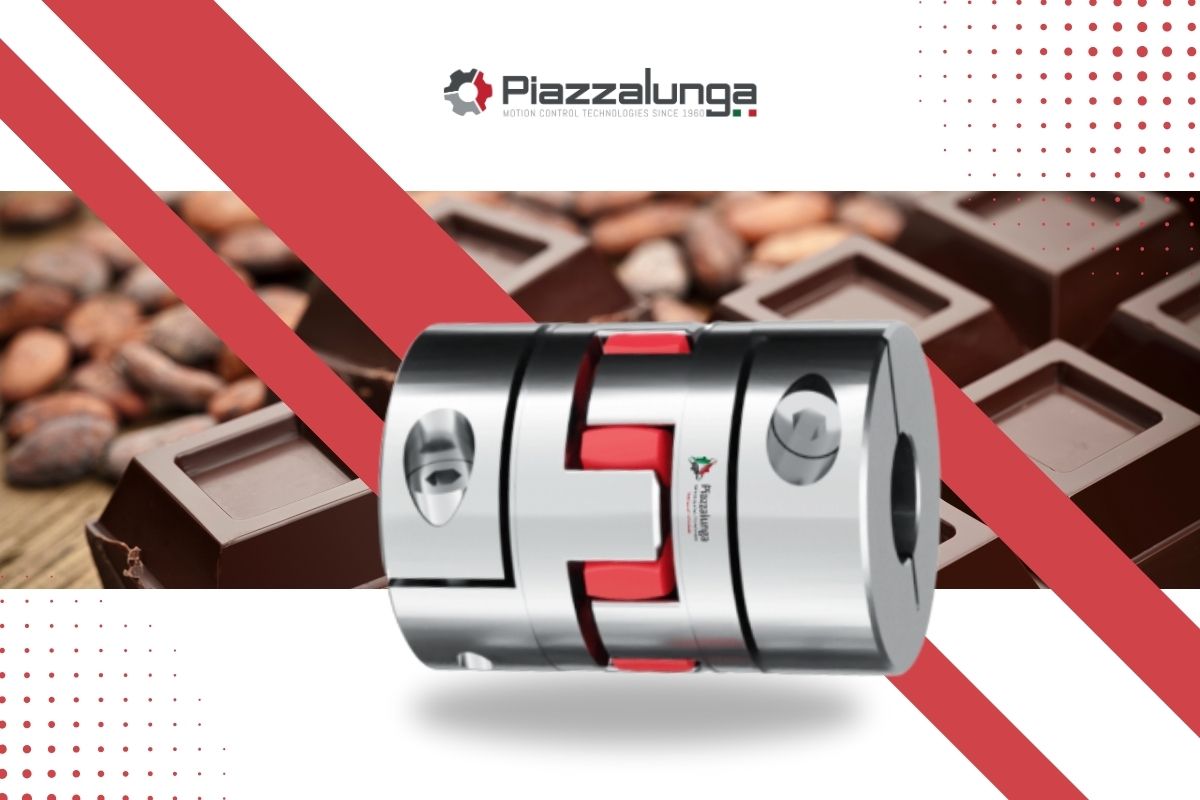
To solve the issue, we proposed our GSTR Elastic Coupling—a component specifically engineered to ensure smooth transmission, precision, and long service life even in harsh environments like those found in the food industry.
Materials and Available Configurations
The GSTR is available in aluminum or stainless steel, offering corrosion resistance, lightweight properties and compatibility with the cleaning requirements typical of food production lines.
It can be supplied in several configurations:
- With bore and keyway;
- With integrated or removable clamp;
- With customized hubs to fit compact spaces.
👉 https://piazzalunga.com/en/product/gstr-series/
Key Benefits
The GSTR is designed to eliminate the critical points typical of transmissions, offering tangible advantages:
✅ Compensates for misalignments between motor and driven shafts, preventing mechanical stress.
✅ Ensures smooth, regular motion, reducing vibration and noise.
✅ Requires no lubrication or routine maintenance, thanks to the elastic element.
✅ Easy to install, with a compact and modular design.
In addition, the elastic element provides a vibration damping function, enhancing the lifespan of connected components such as gearboxes and motors.
Compatibility with Food Environments
The GSTR is the ideal choice where hygiene is a top priority.
Its smooth surface and compact structure minimize the risk of residue buildup, while the absence of lubricants makes it perfectly compatible with food production lines.
It is the perfect coupling for demanding environments with:
- Sugary or fatty residues;
- Fine powders and moisture;
- Frequent washdowns with industrial cleaning agents.
These properties ensure the GSTR maintains consistent performance over time, with no risk of contamination or operational decline.
Benefits for the Plant and Production
After installing the GSTR elastic coupling, our client observed clear, measurable benefits:
- Reduced machine downtime, thanks to the elimination of scheduled maintenance.
- Improved production continuity, with smooth and precise operation.
- Elimination of vibrations and misalignments, improving motion quality.
- Reduced raw material waste, due to consistent dosing and mixing cycles.
- Higher energy efficiency, thanks to optimized transmission.
In a sector where process repeatability is everything, any improvement in transmission translates into consistent product quality—and long-term savings.
When the Coupling Makes the Difference
Choosing the right coupling means investing in reliability, productivity, and safety.
A coupling designed for food environments is not just a technical detail—it’s a component that directly impacts process quality and overall plant performance.
In the case of the GSTR, the combination of robustness, precision, and maintenance-free operation makes it a benchmark solution for:
- Food and confectionery processing systems
- Packaging machines
- Mixing and dosing lines
- Fluid handling equipment
Conclusion
Every food production line comes with its own set of challenges: residues, cleaning cycles, continuous shifts.
The solution often lies in the right mechanical detail.
A coupling like the GSTR can turn a troublesome transmission into a guarantee of efficiency and hygiene.
Whether it’s chocolate, flour, or liquid foods, the philosophy remains the same:
👉 “In mechanics, precision is the first ingredient of quality.”